
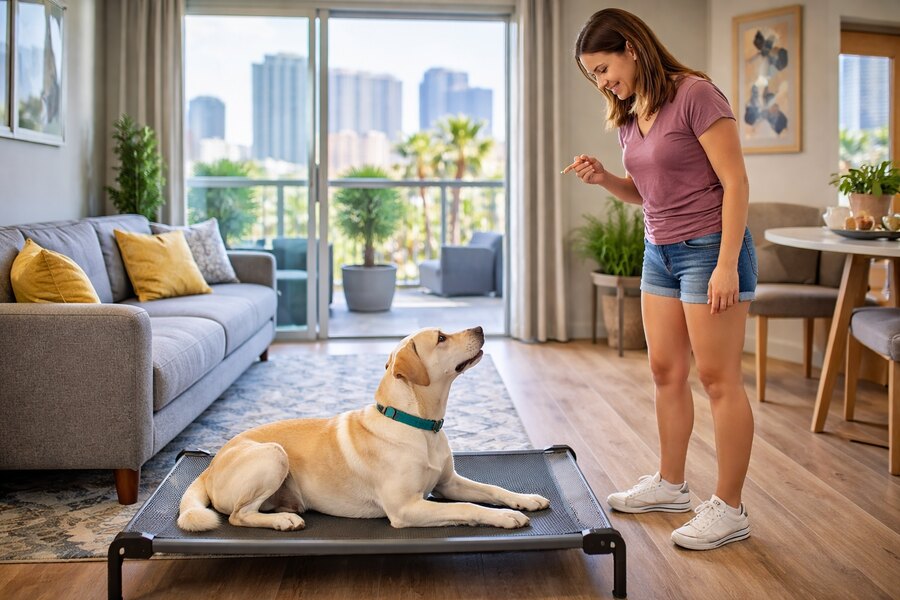
Living in an apartment in Las Vegas doesn’t mean you have to settle for chaos, barking complaints, or a dog who acts like the hallway is a NASCAR track. In fact, apartment dog training in Las Vegas can be more effective than training in a big backyard—because apartment life forces structure, consistency, and real-world distractions (neighbors, elevators, door knocks, and that one guy who always smells like tacos).
If you’re reading this, you’re probably dealing with one (or more) of these apartment-specific headaches:
-
Your dog barks at every sound (doors, voices, footsteps, ghosts—who knows).
-
Your dog pulls you like a sled dog down the corridor.
-
Your dog loses their mind when you leave (separation anxiety).
-
Your dog can’t settle and acts like the living room is a stadium.
-
You’re worried about disturbing neighbors or getting a “final warning” from management.
Here’s the good news: space limitations do not prevent effective dog training. Not even close. With the right approach, you can teach calm behavior, impulse control, polite greetings, leash manners, and quiet confidence—all from a small apartment in the middle of the desert.
This guide will show you how apartment training works, why Las Vegas adds its own unique challenges, and how professional training can help you build a dog who behaves like they actually pay rent.
1. Why Apartment Dog Training in Las Vegas Is Different
Dog training in Las Vegas comes with special ingredients you don’t always find elsewhere:
-
Extreme heat limits exercise and outdoor training for a big chunk of the year.
-
Many apartment complexes have thin walls and noise rules.
-
Hallways, elevators, and shared spaces create constant trigger exposure.
-
Dogs are often under-exercised, overstimulated, and under-trained because it’s hard to “just let them run.”
That combination makes behavior problems show up faster—and louder.
The upside? Training in an apartment gives you built-in opportunities to practice calm behavior around distractions, which often leads to a more reliable dog than the “yard dog” who only behaves at home.
2. Choosing the Best Focus Keyword (SEO + Human Intent)
For this post, the strongest focus keyword is:
✅ apartment dog training Las Vegas
Why this works:
-
It matches what people actually search when they live in a Las Vegas apartment and need training help.
-
It’s specific enough to attract high-intent readers (not just general dog owners).
-
It naturally fits into headings, the opening paragraph, image alt-text, and metadata without sounding awkward.
Secondary keywords we’ll naturally include:
-
dog training for apartments Las Vegas
-
obedience training Las Vegas
3. The Truth About Training in Small Spaces (It’s Not a Handicap)
A lot of owners assume they need a backyard to train a dog well. That’s like assuming you need a full gym to get fit. Helpful? Sure. Required? Nope.
Dogs learn through:
-
repetition
-
consistency
-
reward timing
-
clear boundaries
-
structured exposure to distractions
None of those require a big space. What they require is a plan.
In fact, apartment training can be easier in some ways because:
-
You control the environment better.
-
Your dog spends more time close to you (more learning opportunities).
-
Small spaces encourage calm routines instead of constant zooming.
Small space doesn’t block training. Lack of structure does.
4. The #1 Apartment Complaint: Barking (And How to Fix It)
In apartments, barking isn’t just annoying—it can be a lease violation. And in Las Vegas, where buildings often have hard surfaces and echo-y hallways, barking travels like sound has a personal vendetta.
Why dogs bark more in apartments
-
They hear constant hallway noise
-
They see movement through windows/balconies
-
They’re bored and under-stimulated
-
They’ve learned barking works (attention, reaction, engagement)
What works (and what doesn’t)
Doesn’t work:
-
Yelling (it sounds like you’re barking too)
-
Shock collars without a training plan
-
“Just ignore it” when the barking is rehearsed daily
Works:
-
Teaching a replacement behavior (place command, quiet cue)
-
Building impulse control
-
Structured exposure to triggers
-
Correcting the emotional response (calm neutrality)
This is one of the biggest places professional training shines, because barking is rarely just a “noise problem.” It’s usually an arousal + habit + communication problem.
5. Impulse Control: The Superpower Apartment Dogs Need
Impulse control is the difference between:
-
a dog who can chill while you answer the door
and
-
a dog who tries to launch through it like a missile.
Apartment life is full of tight spaces, sudden people, and surprise interactions. That means impulse control isn’t optional—it’s survival.
Apartment impulse control skills that matter most
-
Place command (go to bed/mat and stay)
-
Doorway manners
-
Leash calmness in hallways
-
Ignoring distractions (dogs, kids, carts, elevators)
-
Settle on command (especially during work-from-home hours)
Impulse control doesn’t come from “more exercise.” It comes from training the brain to pause, think, and respond.
6. Potty Training in Apartments (Without Losing Your Mind)
Apartment potty training can feel like playing life on hard mode. Instead of a quick backdoor trip, you’ve got:
-
leash clipping
-
elevator waiting
-
hallway navigation
-
outdoor walk to designated area
-
distractions everywhere
That’s why so many apartment dogs have accidents for longer than expected—especially puppies.
How to win at apartment potty training
-
Use a strict schedule (not “when they seem like they need to go”)
-
Track water intake
-
Use crate training or confinement between potty trips
-
Reward outside immediately
-
Don’t punish accidents (punishment makes sneaky pee, not potty training)
In Las Vegas heat, early morning and late evening potty trips are often best—especially for small breeds and brachycephalic dogs (like pugs and bulldogs).
7. Leash Training for Apartment Hallways and Elevators
Leash training in a neighborhood is one thing. Leash training in an apartment hallway is a whole different sport.
Hallways are narrow, echo-y, and packed with unavoidable triggers. Dogs often feel trapped, which can trigger:
-
pulling
-
lunging
-
barking
-
reactivity
-
fear responses
What your dog needs to learn
-
Walk beside you (not drag you)
-
Stop at doors and corners
-
Ignore sudden noises
-
Stay neutral around strangers
This is where obedience training Las Vegas programs can be a game-changer, because leash skills aren’t just about walking—they’re about control in high-distraction environments.
8. Mental Exercise: Your Secret Weapon in Small Spaces
Let’s say it plainly: you cannot out-walk a bored dog.
Especially in Las Vegas summers when it’s 112°F outside and the sidewalk is basically a frying pan.
Mental exercise tires dogs faster than physical exercise, and it’s perfect for apartment living.
Apartment-friendly mental stimulation ideas
-
Food puzzles and slow feeders
-
Nose work games (“find it”)
-
Structured obedience sessions (5–10 minutes, multiple times a day)
-
Place command with duration
-
“Leave it” games
-
Recall practice in the hallway (when safe)
Even 15 minutes of real training can outperform an hour of distracted walking.
And the best part? Your dog starts to think before reacting, which solves half of apartment behavior problems.
9. Separation Anxiety in Apartments: The Silent Stress Monster
Separation anxiety hits apartment dogs hard, because:
-
the environment is tighter
-
sounds outside increase alertness
-
neighbors hear everything
-
many dogs become overly attached due to constant proximity
Signs include:
-
barking/howling when you leave
-
scratching doors
-
pacing
-
drooling
-
destructive chewing
-
accidents even when house-trained
Why professional help matters
Separation anxiety is one of those problems where DIY attempts can accidentally make it worse (especially if you “test” your dog repeatedly by leaving and returning).
The solution involves:
-
building independence
-
systematic desensitization
-
calming routines
-
sometimes structured obedience work to reduce overall anxiety
A good trainer helps you stop guessing and start fixing.
10. Socialization for Apartment Dogs (Without Chaos)
Apartment dogs meet more strangers and dogs than many suburban dogs. That sounds like great socialization… until it isn’t.
Real socialization is not:
-
letting every dog greet every dog
-
letting strangers pet your dog nonstop
-
dragging your dog into stressful interactions
Real socialization is:
-
neutral exposure
-
teaching your dog how to ignore distractions
-
building confidence through calm repetition
In other words: your dog doesn’t need to love everyone. They need to behave around everyone.
This is a huge difference, and it’s one of the core reasons dog training for apartments Las Vegas is so valuable—apartment dogs need urban manners, not just backyard manners.
11. Common Apartment Dog Behavior Problems (And What They Really Mean)
Let’s decode the usual apartment chaos:
Problem: Jumping on guests
Usually means: overstimulation + no boundaries + attention reinforcement
Problem: Barking at door noises
Usually means: alert behavior + anxiety + rehearsed habit
Problem: Pulling on leash
Usually means: no structure + excitement + lack of handler leadership
Problem: Reactivity to other dogs
Usually means: fear, frustration, or over-arousal (not “dominance”)
Problem: Can’t settle indoors
Usually means: too much freedom, too little structure, too little mental exercise
Most of these issues aren’t “bad dog problems.” They’re untrained nervous system problems—and those are absolutely fixable.
12. Why Professional Apartment Dog Training in Las Vegas Works Faster
Here’s what a professional brings that most owners don’t:
-
A clear behavior plan (no guessing)
-
Proper timing (rewards, corrections, cues)
-
Tools used correctly (and humanely)
-
Accountability and follow-through
-
Real-world exposure training (hallways, parks, stores, distractions)
Training isn’t just about teaching commands—it’s about building a dog who can function calmly in real life.
And in an apartment, “real life” includes:
-
neighbors walking past your door
-
delivery drivers
-
elevators
-
barking dogs down the hall
-
kids sprinting like chaotic goblins
Professional training creates a dog who doesn’t fall apart when the world moves.
13. Apartment Training Tips You Can Start Today
Here are practical steps you can begin immediately—no extra space required:
1) Use the “Place” Command Daily
Teach your dog that calm is a job. Feed meals on place. Reward settling.
2) Stop Free Roaming
Too much freedom makes dogs self-employed. Structure builds calm behavior.
3) Train in Micro-Sessions
3–5 minutes, 3–5 times per day works better than one long session.
4) Reward Quiet
Don’t just punish barking—catch calm moments and pay them.
5) Build Routine
Dogs thrive when life is predictable. Unpredictability fuels anxiety.
This is the foundation of great apartment behavior.
14. Call to Action: Get Real Results with Off Leash K9 Training of Las Vegas
Apartment living should not feel like you’re constantly negotiating peace treaties between your dog and your neighbors.
With the right training, your dog can learn:
-
quiet, calm behavior indoors
-
leash manners in hallways and elevators
-
impulse control around distractions
-
reliable obedience in real-world situations
-
confidence without reactivity
At Off Leash K9 Training of Las Vegas, we specialize in real-life obedience that works in the environments where you actually live—apartments included. Whether your goal is calmer indoor behavior, better leash control, or a dog you can confidently take hiking and trust off-leash, we can help you get there.
Ready for a quieter apartment and a more obedient dog? Contact Off Leash K9 Training of Las Vegas today and let’s build a dog you’re proud to live with.
Conclusion
Apartment living in Las Vegas comes with unique challenges for dog owners—limited space, shared walls, constant distractions, and heat that makes outdoor time tough. But none of these obstacles prevent great training. With structured routines, mental exercise, impulse control, and professional guidance when needed, your dog can learn calm, polite behavior that makes apartment life enjoyable instead of stressful. Apartment dog training in Las Vegas isn’t about having more space—it’s about having a better plan.