
Las Vegas is a city built for stimulation. Bright lights. Loud music. Crowds everywhere. Street performers. Rolling suitcases. Elevators. Escalators. Weird statues that look like they might come alive at night. It’s fun for humans — but for many dogs, it can feel like being dropped into the middle of a never-ending sensory hurricane.
If you’ve ever walked your dog near the Strip, Downtown Summerlin, Fremont Street, or even a busy neighborhood park during peak tourist season, you’ve probably seen it: your dog suddenly barks, lunges, freezes, pulls, whines, spins, or panics. Sometimes it looks like “bad behavior.” But most of the time, it’s actually something much more understandable:
Your dog is overwhelmed.
This is one of the biggest reasons reactive dog training Las Vegas has become such a high-demand service. Not because Las Vegas dogs are “worse,” but because Las Vegas is an unusually intense environment — and dogs respond to intense environments with intense behavior.
In this article, we’re going to break down:
-
Why crowds and tourism commonly trigger reactivity and anxiety
-
How overstimulation changes dog behavior
-
Why some dogs struggle more than others
-
How structured training (especially distraction training) creates calm, focused dogs
-
How you can start helping your dog immediately
-
When professional training becomes the smart move
And yes — we’ll do it in a way that actually makes sense (without fluffy nonsense).
Why Las Vegas Is a Perfect Storm for Dog Reactivity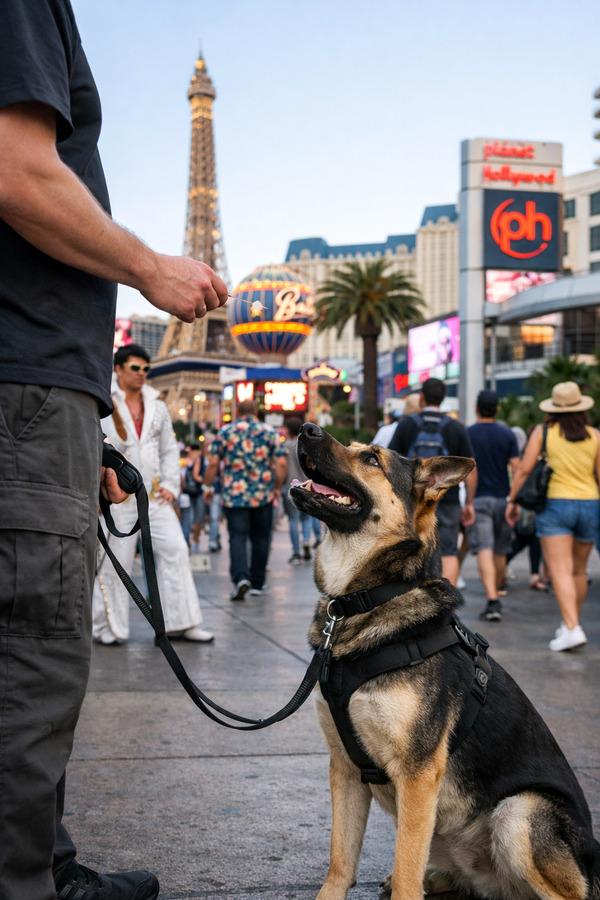
Most cities have crowds. But Las Vegas has crowds + unpredictability + intensity.
Here’s what makes Vegas uniquely challenging for dogs:
1) Constant foot traffic
Even outside the Strip, Vegas is loaded with foot traffic: outdoor malls, hotel walkways, high-density apartment complexes, dog-friendly patios, and packed parks.
2) Unfamiliar people behave differently here
In Vegas, people:
-
Dress unusually (costumes, glitter, hats, uniforms)
-
Move unpredictably (drunk wobbling, dancing, sudden running)
-
Make strange noises (whooping, yelling, laughing loudly)
-
Try to pet dogs without asking (tourist behavior is… enthusiastic)
3) Noise pollution is next-level
Sirens, music, fireworks, construction, loud engines, rolling suitcases, bus brakes, motorcycle revving — Vegas doesn’t do “quiet.”
4) Tight spaces everywhere
Narrow sidewalks, elevators, escalators, crowded hotel entrances, and packed crosswalks create the exact conditions that make reactive dogs feel trapped.
So if your dog is reactive here, it’s not shocking. It’s predictable.
What Dog Reactivity Actually Is (And What It Isn’t)
Let’s clear this up: reactivity is not the same as aggression.
A reactive dog is a dog that over-responds to a stimulus. That stimulus might be:
-
other dogs
-
strangers
-
kids
-
bikes or scooters
-
loud sounds
-
costumes
-
someone walking too close
-
skateboards
-
people carrying bags
Reactivity often looks like:
-
barking
-
lunging
-
growling
-
snapping
-
spinning
-
freezing
-
bolting
-
whining
-
panting
-
refusing to move
But underneath that behavior is usually one of these emotional states:
✅ Fear (“That thing is scary and too close.”)
✅ Frustration (“I want to greet that dog but I can’t!”)
✅ Over-arousal (“Everything is happening and my brain is melting.”)
✅ Defensiveness (“If I bark first, you’ll stay away.”)
Vegas pushes all of those buttons very efficiently.
How Crowds Trigger Anxiety in Dogs
Dogs are constantly taking in information. Smells. Motion. Sound. Distance. Body language. A calm environment gives their brain time to process.
A crowded environment does the opposite: it forces the brain to process too much, too fast.
Imagine you’re in a packed casino, but you’re barefoot, you don’t speak the language, and half the people are twice your size and staring at you. That’s basically the dog version of the Strip.
Crowds trigger anxiety because they create:
-
tight proximity
-
unpredictable movement
-
lack of escape routes
-
sensory overload
-
loss of control
And anxiety isn’t always dramatic — sometimes it’s subtle. The early warning signs include:
-
lip licking
-
yawning when not tired
-
shaking off (when not wet)
-
whale eye (showing whites of eyes)
-
sniffing obsessively
-
pacing
-
panting
-
refusing treats
-
pinned-back ears
-
stiff posture
When those signs are ignored, the dog escalates — because escalation is how animals create space.
The “Overstimulation Bucket” — Why Vegas Dogs Blow Up Faster
Here’s a concept trainers love because it’s dead accurate:
Your dog has a stress bucket.
Every trigger adds water. A calm situation drains water. When the bucket overflows… boom: reactivity.
In Vegas, your dog’s bucket fills fast from:
-
heat
-
noise
-
crowds
-
unfamiliar smells
-
unpredictable people
-
other reactive dogs
-
traffic
-
flashing lights
-
chaotic energy
So your dog might seem “fine” at minute 1… and totally lose it by minute 12. That doesn’t mean they’re stubborn. It means the bucket is full.
This is one reason dog behavior training Las Vegas has to focus heavily on exposure + coping + skills, not just obedience commands.
Why Some Dogs Become Reactive in Las Vegas (Even If They Were Fine Before)
This surprises a lot of owners:
A dog can move to Vegas and become reactive after arriving.
That’s because reactivity isn’t always genetic. It often develops from:
1) Under-socialization
Dogs that weren’t properly introduced to people, sounds, and environments during puppyhood tend to struggle more.
2) Single scary events
One bad incident — like being rushed by an off-leash dog at a park — can imprint fear in a dog’s brain.
3) Chronic stress
Even mild stress that happens every day can build into bigger reactions over time.
4) Owners unintentionally reinforcing stress
If every time your dog reacts you:
-
pick them up
-
flee rapidly
-
tense the leash
-
panic
-
shout
…your dog learns the trigger really is dangerous, and their reaction was justified.
(Yes, this is unintentional. No, you’re not a bad person. But it matters.)
Tourist Behavior That Commonly Sets Dogs Off
Vegas tourists are many things. Calm and dog-savvy is… not always one of them.
Some common crowd behaviors that trigger dogs include:
-
sudden bending over a dog’s head
-
reaching without asking
-
staring directly at the dog
-
high-pitched squealing (“AWWW PUPPYYYY!”)
-
drunk people moving unpredictably
-
people trying to take selfies with dogs
-
children running straight toward the dog
-
costumes and masks
-
loud cheering
-
strange props (balloons, strollers, scooters)
Dogs experience these things as confrontational or threatening — even if the person means well.
And because Vegas has so many of these interactions, reactive behavior becomes more likely… unless the dog is trained to handle it.
The Role of Leash Pressure in Reactivity
One of the biggest amplifiers of reactive behavior is the leash.
Not because leashes are bad — they’re essential — but because the leash changes how dogs feel:
-
It removes their ability to create space
-
It prevents natural greetings
-
It adds physical tension to emotional tension
-
It can accidentally signal “danger is coming” if the owner tightens up
If a dog sees a trigger and the leash immediately tightens, the dog learns:
Trigger = leash tension = danger.
This is why many reactive dog training Las Vegas programs focus heavily on:
-
loose-leash walking
-
neutral engagement
-
structured movement
-
handler calmness
-
leash communication
Because leash handling isn’t just mechanics — it’s emotional information.
Why “Just Socialize Them More” Often Backfires
People love giving this advice:
“Just take them around more people and they’ll get used to it.”
That sounds logical. It’s also frequently wrong.
If a dog is already reactive, flooding them with crowds can:
-
increase fear
-
create worse reactions
-
damage trust
-
worsen anxiety
-
cause shutdown behavior
-
escalate into real aggression
The correct approach is structured exposure, not forced exposure.
Training should happen:
-
at a distance where the dog can stay calm
-
in short sessions
-
with clear expectations
-
with reward for calm behavior
-
while gradually decreasing distance over time
That’s desensitization + counterconditioning — and it works when done correctly.
What “Distraction Training” Really Means (And Why Vegas Dogs Need It)
One of the most important skills for Las Vegas dogs is distraction training dogs.
Distraction training teaches your dog:
-
how to stay engaged with you even when the world is loud
-
how to ignore people, dogs, food, noises, and chaos
-
how to regulate excitement instead of exploding
-
how to “work through” high stimulation
This isn’t about turning your dog into a robot. It’s about building the ability to think while excited — which is a huge deal.
A distracted dog isn’t disobedient. They’re overwhelmed. Distraction training rewires that response.
The 5 Core Skills That Help Reactive Dogs Stay Calm in Crowds
When a dog is reactive, the goal isn’t “never react.” The goal is:
reduce intensity, increase control, build confidence, and create calm patterns.
Here are five skills that consistently help:
1) Neutral exposure
Learning to observe triggers without reacting.
2) Place / settle
Teaching a dog to relax on command — huge for patios and public spaces.
3) Structured heel
Not for perfection — but for clarity. A dog with a job is calmer than a dog without one.
4) Focus command
A reliable “look at me” becomes your dog’s mental reset button.
5) Impulse control
Dogs that can delay gratification are far less likely to explode at triggers.
These skills are foundational in high-quality dog behavior training Las Vegas programs for reactive dogs.
Realistic Places in Las Vegas to Practice Crowd Training
Vegas can be intense, so the smartest strategy is to scale difficulty gradually.
Here are great training locations (from easiest to hardest):
Low distraction
-
quiet neighborhood sidewalks
-
empty school parking lots
-
early-morning parks
-
wide open spaces
Moderate distraction
-
local parks during off-peak hours
-
outdoor shopping centers early in the day
-
pet-friendly hardware stores
-
trails with occasional foot traffic
High distraction
-
Downtown Summerlin (busy times)
-
Fremont Street area
-
The Strip (especially evenings)
-
casinos and hotels with high foot traffic (where allowed)
A good training program treats Vegas like a video game:
you don’t fight the boss on level one.
What Owners Can Do Immediately to Reduce Reactivity
You don’t need to wait for a full training program to begin improving things.
Here are immediate, practical changes:
1) Stop walking into chaos
Avoid peak crowd times until your dog has more skills.
2) Increase distance
Distance is the easiest way to reduce reactivity. It works instantly.
3) Reward calm observation
If your dog can look at a trigger without reacting — reward that like they just solved world hunger.
4) Don’t punish fear
Punishment may suppress behavior short-term but often increases anxiety long-term.
5) Use structured movement
Move with purpose. Wandering gives your dog too many chances to fixate.
These steps don’t replace professional training — but they help stabilize things fast.
When Professional Reactive Dog Training Becomes the Best Option
Reactive behavior isn’t something you should “wait out.”
You should strongly consider professional help if:
-
your dog lunges or snaps at people/dogs
-
your dog has bitten or attempted to bite
-
reactions are worsening
-
you avoid walking your dog out of fear
-
your dog can’t recover quickly after triggers
-
your dog reacts from long distances
-
you feel overwhelmed or frustrated
This is exactly where reactive dog training Las Vegas becomes life-changing — not just for the dog, but for you.
How Structured Training Changes a Dog’s Brain
Training isn’t just “teaching commands.” It creates measurable behavioral changes:
-
predictability reduces anxiety
-
structure creates safety
-
skills replace panic
-
repetition creates confidence
-
calm behavior becomes a habit
-
dogs learn how to self-regulate
-
handlers learn how to lead
A well-trained dog doesn’t magically stop feeling emotions — but they stop being controlled by them.
That’s the real win.
Why Las Vegas Dogs Can Become Some of the Best-Behaved Dogs Anywhere
Here’s the weird paradox:
Vegas is harder… which means Vegas dogs can become incredibly solid once trained.
A dog trained to ignore:
-
street performers
-
crowds
-
loud noises
-
tourist chaos
-
other dogs
-
flashing lights
…is basically unstoppable anywhere else.
Vegas becomes the ultimate training gym. If your dog can handle this city, they can handle almost anything.
Conclusion: Vegas Crowds Don’t Have to Control Your Dog’s Behavior
Las Vegas is intense, crowded, noisy, and full of unpredictable humans doing unpredictable human things. For many dogs, that environment naturally increases reactivity, anxiety, and overstimulation — especially without structured support.
But the good news is this: reactivity is not a life sentence.
With the right combination of:
-
structured exposure
-
distraction training
-
obedience foundations
-
impulse control
-
handler skills
-
confidence building
…most dogs can learn to stay calm, focused, and safe — even in the chaos of Vegas.
Call to Action
If you’re tired of stressful walks, public meltdowns, or feeling like you can’t take your dog anywhere, professional help can change everything. If you’re looking for reactive dog training Las Vegas, contact Off Leash K9 Training of Las Vegas to get a training plan built around your dog, your lifestyle, and the reality of living in a high-distraction city. With the right training, you can take your dog into crowds, on hikes, to parks, and out into the world with confidence.