
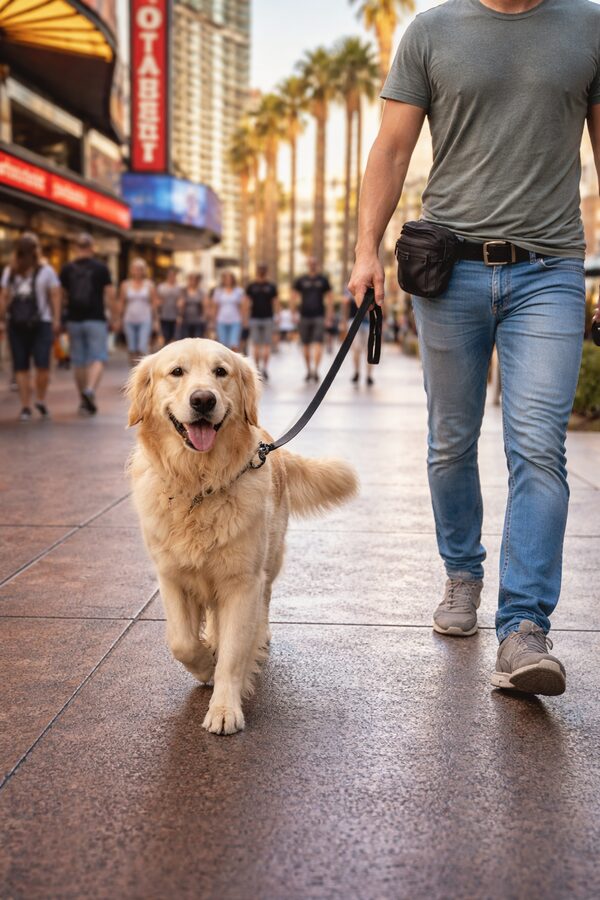
Las Vegas is a city built for movement—cars, crowds, tourists, scooters, strollers, delivery drivers, and people who seem to materialize out of nowhere with a suitcase and a giant margarita. That constant motion is exactly why leash training Las Vegas isn’t just a “nice-to-have” skill for dog owners… it’s a safety system.
In quieter towns, a dog pulling on a leash is annoying. In Las Vegas, leash pulling can turn into a dangerous chain reaction: a dog darts toward traffic, slips a collar, knocks someone over, panics in a crowd, reacts to another dog, or pulls an owner into the street at the worst possible time.
Reliable leash manners are about more than comfort. They’re about control, predictability, and trust—three things you absolutely need in a high-traffic city with overstimulation around every corner.
This article will break down why leash training matters more in Las Vegas than most places, what can go wrong without it, and how professional training helps you build calm, reliable leash skills that keep both you and your dog safe.
1. Las Vegas Isn’t a “Normal” Dog-Walking City
Las Vegas is unique in a way that matters a lot for dog owners:
-
High pedestrian density (especially near the Strip, Downtown, and shopping districts)
-
Extreme heat and reflective pavement
-
Tourist unpredictability (people approach dogs constantly)
-
Traffic and noise overload
-
A huge mix of dogs from different training backgrounds
A dog that walks “fine” in a quiet neighborhood might fall apart when suddenly exposed to loud music, casinos, golf carts, dogs on retractable leashes, or a family of five walking out of a hotel with balloons and snacks.
That’s why dog walking training Las Vegas needs to focus on real-world stability, not just backyard obedience.
2. The Real Problem Isn’t Pulling — It’s What Pulling Leads To
Most people think leash pulling is mainly a comfort issue: sore arms, frustration, embarrassment.
But pulling is often a symptom of a bigger issue, and that bigger issue is the real danger: your dog is moving first, thinking second.
That’s the opposite of what you want in a city environment.
Pulling can lead to:
-
Sudden lunges toward traffic
-
Tripping or pulling over kids or seniors
-
Escapes when collars/harnesses fail
-
Dog-to-dog reactions that escalate
-
Bites caused by panic or leash frustration
-
You losing control at exactly the wrong moment
In other words, pulling is rarely “just pulling.” It’s a preview of what your dog will do when overstimulated.
3. Busy Sidewalks + Untrained Leash Manners = Liability
Las Vegas sidewalks are often packed—especially in areas like:
-
Downtown Summerlin
-
The Arts District
-
Fremont Street
-
Red Rock visitor areas
-
Local parks and trails
-
Outdoor malls and patios
Even a friendly dog can create a problem if they:
-
Jump on strangers
-
Rush kids
-
Pull toward another dog
-
Knock someone holding drinks or bags
If your dog causes an injury or triggers an incident, you may be held responsible—even if it was unintentional. That’s why leash manners should be treated like basic public safety, not optional etiquette.
Also worth noting: Las Vegas and surrounding areas enforce leash rules, and violations can carry penalties depending on jurisdiction. Clark County and nearby cities generally require dogs to be leashed in public areas unless in designated spaces.
4. Leash Reactivity Is Common in Las Vegas (And It Spreads Fast)
One of the most common behavioral problems trainers see is leash reactivity—barking, lunging, or growling on leash, usually toward other dogs (sometimes people).
In a dense city, leash reactivity happens more often because:
-
Dogs are forced into close passing distances
-
Many owners use retractable leashes
-
Sidewalks are narrow
-
Dogs can’t “escape” stressors
-
Other dogs may be untrained or unpredictable
When dogs feel trapped and overstimulated, they may react.
Professional leash training Las Vegas isn’t just about walking nicely. It’s also about teaching your dog how to stay neutral around triggers and return focus to you.
5. Heat Changes Everything — Especially on a Leash
Las Vegas heat isn’t just uncomfortable—it changes canine behavior and safety dramatically.
During hotter months:
-
Pavement temperatures can burn paws quickly
-
Dogs fatigue faster
-
Overheating increases irritability and stress
-
Water needs become urgent
-
Short walks can still become dangerous
Dogs that pull in summer create added risk because they:
-
Move too fast and overheat sooner
-
Don’t pause for cooling breaks
-
Become harder to manage when stressed
-
Can slip out of gear if panicking
Leash training gives you the ability to slow your dog down, maintain control, and redirect them calmly when they’re overstimulated by heat or crowds.
6. Las Vegas Has More “Surprise Encounters” Than Most Cities
In a calmer neighborhood, you can often see things coming: another dog, a bike, a jogger.
Las Vegas is a different story.
You get surprise encounters constantly:
-
Someone stepping out of an Uber
-
A skateboard flying past
-
A child sprinting unexpectedly
-
A dog turning a corner two feet away
-
Loudspeakers, music, fountain shows
-
Hotel carts, delivery robots, scooters
Your dog doesn’t need to be aggressive for these to become dangerous situations. They just need to be unpredictable.
Leash training isn’t about forcing your dog to be robotic. It’s about building a reliable baseline response:
✅ “I feel something big… but I stay with my human.”
7. Why “Just Use a Harness” Isn’t a Real Solution
Harnesses can be helpful tools. But they don’t teach leash manners by themselves.
Many owners switch to a harness hoping it will fix pulling, but here’s what often happens:
-
The dog pulls even harder (because they can use their whole body)
-
The owner feels less control
-
The dog learns pulling still works
-
The habit becomes more ingrained
Tools don’t replace training. They support training.
A properly trained dog can walk on:
-
A flat collar
-
A slip lead
-
A harness
-
A prong collar (when used correctly and humanely)
But an untrained dog will pull on anything.
If your goal is to stop leash pulling Las Vegas, you need a training plan—not just equipment.
8. Real Leash Training Builds Skills, Not Just Compliance
A lot of people picture leash training as:
“Stop pulling. Walk beside me.”
But effective training builds something deeper:
Key leash skills every Las Vegas dog needs
-
Loose leash walking (no tension on leash)
-
Structured heel (when needed in crowds or traffic)
-
Automatic check-ins (dog re-engages with you)
-
Impulse control (dog doesn’t chase distractions)
-
Threshold control (dog doesn’t bolt out doors or cars)
-
Neutrality (dog can pass people/dogs calmly)
The goal isn’t perfection. The goal is reliability under distraction.
That’s the difference between a dog that behaves in your living room and a dog you can trust outside a busy casino entrance.
9. The “Vegas Factor”: Your Dog Needs Urban Proofing
In dog training, “proofing” means teaching a behavior until it holds up under increasing distraction.
Las Vegas is basically a real-world proofing arena:
-
Neon lights
-
Crowds
-
Food smells everywhere
-
Loud noises
-
Unpredictable people
-
Constant motion
So leash training here should include:
-
Outdoor malls
-
Parks with heavy foot traffic
-
Busy intersections
-
Trailheads
-
Pet-friendly patios
-
Environments with other dogs nearby
This is why professional programs often train dogs in public environments—because that’s where the behavior needs to work.
Off Leash K9 Training of Las Vegas even specifically notes training in high-distraction real-world areas like outdoor malls and shopping centers—exactly the kind of environments where leash manners matter most.
10. Common Mistakes That Make Leash Pulling Worse
Pulling is one of those behaviors that gets reinforced accidentally. Here are the most common mistakes that increase it:
Mistake #1: Letting pulling “work”
If your dog pulls you to a tree, and they get to sniff it, you just taught them:
Pulling = success.
Mistake #2: Using a retractable leash
Retractable leashes encourage forward pressure and unpredictable distance. They also reduce your ability to stop sudden lunges.
Mistake #3: Only training when things go wrong
Training needs to happen during calm moments too—otherwise your dog only practices under stress.
Mistake #4: Correcting without teaching
Corrections without clear communication create frustration. You need a complete system: guidance, reinforcement, and accountability.
Mistake #5: Expecting “exercise” to fix behavior
Exercise helps, but it doesn’t teach impulse control. A tired dog can still lunge, react, or panic.
11. How Professional Leash Training Changes the Game
Professional leash training works faster because it:
-
Identifies the root cause of pulling (excitement, anxiety, habit, lack of engagement)
-
Builds a structured training plan
-
Uses proper timing and consistency
-
Trains the dog in real environments
-
Teaches owners how to maintain results
Most importantly: it reduces the emotional chaos that often surrounds leash issues. Pulling tends to create frustration on both sides. Professional help brings clarity.
When you hire a real leash training program, you’re not buying “walking tips.”
You’re buying safety, confidence, and freedom.
12. What Leash Training Looks Like When It’s Done Right
A well-trained leash walk isn’t about your dog staring at you constantly like a robotic soldier.
It looks like this:
-
Your dog walks calmly with a loose leash
-
They’re allowed to sniff when you give permission
-
They can pass people and dogs without drama
-
You can stop and they stop
-
You can change direction and they follow
-
You don’t need to fight them every step
That’s the real goal: a dog who can enjoy the world without being ruled by it.
13. Leash Training Also Improves Off-Leash Reliability (Yes, Really)
Here’s a sneaky training truth:
A dog who can’t control themselves on leash rarely becomes reliable off leash.
Why?
Because leash training teaches:
-
Focus
-
Impulse control
-
Responsiveness
-
Follow-through
-
Respect for boundaries
Those same skills are what make off-leash freedom possible.
So even if your bigger dream is hiking at Red Rock or exploring trails with confidence, leash training is often the first step toward that goal.
14. The Emotional Benefit: Walks Become Enjoyable Again
A lot of owners stop walking their dogs because it’s stressful:
-
The dog pulls nonstop
-
The owner feels judged
-
Every walk becomes a battle
-
They dread passing other dogs
This creates a cycle where:
Less walking → more pent-up energy → more pulling/reactivity → even less walking.
Leash training breaks that cycle.
When leash manners improve, owners walk more, dogs behave better, and everyone’s quality of life rises. It’s one of the highest “return on effort” training investments you can make.
15. Conclusion: In Las Vegas, Leash Training Isn’t Optional
Las Vegas is a fast-moving, high-distraction, high-traffic city—and that reality changes the stakes for dog owners.
In a place like this, leash training Las Vegas isn’t about having a polite dog. It’s about having a safe dog.
Reliable leash manners protect:
-
Your dog
-
Your family
-
Other dogs
-
Your community
-
And your own peace of mind
If you’re dealing with pulling, lunging, reactivity, or just chaotic walks, professional training can take you from frustration to freedom.
Call to Action
If you want to take your dog for walks without stress, stop leash pulling for good, and build real-world reliability you can trust, contact Off Leash K9 Training of Las Vegas today. Whether your goal is calm city walks, safer outings, or eventually off-leash adventures, we’ll help you build the leash skills that make everything else possible.